If your roof is damaged or leaking after a storm in Melbourne, prioritise safety, document what happened, contact your insurer promptly, and call Metropolitan Roof Repairs on (03) 8678 0398 if you need the roof inspected, made safe or repaired.
Metropolitan Roof Repairs brings more than 30 years of roofing experience across Melbourne. The team regularly investigates leaking and storm-damaged tile, slate and metal roofs, including damage to tiles, flashing, valleys, ridge capping and other common points of water entry.
This guide brings together the current roof and home-claim information published by eight major Australian insurers. It is designed as a practical directory, not an assessment of which insurer is better and not a prediction of whether an individual claim will be accepted. Your insurer decides how your policy applies to the damage.
If you are primarily trying to understand whether the cause of your leak may fall within home insurance, start with our separate guide to roof leaks and home insurance.
Melbourne Roof Insurance Claim Directory
The basic first steps are similar across insurers, but their published processes differ once emergency work, assessment and permanent repairs are considered.
The directory below links directly to the insurers’ own claims information rather than comparison websites or third-party summaries.
| Insurer | Start a Home Claim | Useful Published Guidance for Roof Damage |
|---|---|---|
| RACV | Official RACV home claims 13 19 03 | RACV may arrange temporary repairs or inspect building damage. Its current guidance also explicitly allows homeowners to choose their own repairer, subject to RACV’s assessed fair and reasonable repair amount. |
| AAMI | Official AAMI home claims 13 22 44 | AAMI can arrange emergency supplier-network work such as roof tarping. For accepted repairs, it publishes an insurer-managed builder option and a cash-settlement route for homeowners arranging their own builder. |
| Allianz | Official Allianz home claims 13 10 13 | Allianz may appoint a loss adjuster or external expert to investigate damage. Its claims guidance specifically notes that a leaking roof caused by poor maintenance may be treated differently from damage caused by an insured event. |
| Budget Direct | Official Budget Direct claims 1800 069 336 | Budget Direct can arrange emergency make-safe work. If emergency work is arranged independently, invoices, receipts and photographs can be submitted for review as part of the claim. |
| QBE | Official QBE home claims 133 723 | QBE may appoint a loss adjuster or service provider to inspect the damage. For insurer-managed building repairs it uses preferred builders and a scope of works describing the proposed repair work. |
| Youi | Official Youi claims 13 9684 (13 YOUI) | Youi provides 24/7 claims lodgement and may arrange inspections or specialists to assess the cause and extent of damage. It also publishes separate guidance specifically about leaking roofs. |
| GIO | Official GIO home claims 13 10 10 | GIO can arrange an urgent make-safe such as temporary roof tarping. Insurer-managed repairs use its supplier network, while a cash settlement can provide a separate route for arranging your own builder. |
| NRMA Insurance | Official NRMA home claims 131 123 | NRMA can organise urgent repairs through its Partner Repairer network or authorise emergency repairs. It also explicitly publishes an option to choose your own repairer, subject to its assessed repair amount. |
Directory reviewed 20 August 2026. Claims numbers, procedures and policy terms can change. Always check the insurer’s current information and the PDS applying to your individual policy.
What to Do After Storm or Roof Damage
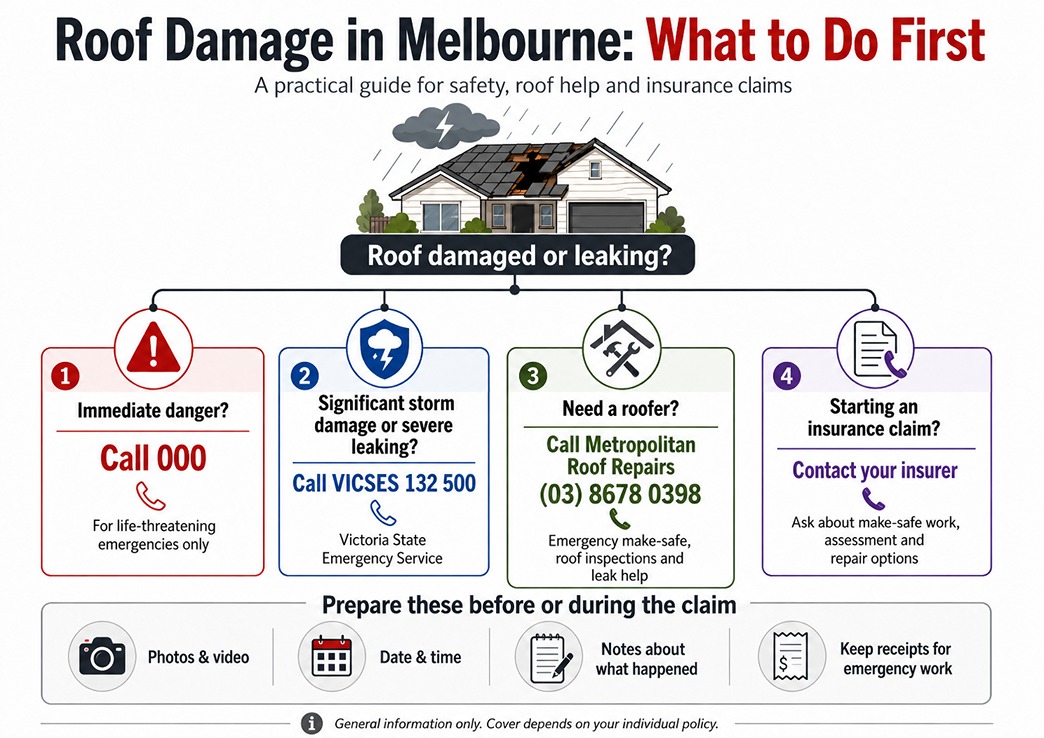
Safety comes before documentation. Do not climb onto a wet or visibly damaged roof to inspect tiles or obtain photographs.
1. Photograph What You Can Safely See
Photographs and video are repeatedly requested across insurer claims guidance. Useful evidence can include:
- missing, cracked or displaced roofing visible from ground level;
- tree or debris impact;
- internal water entry;
- wet ceilings and walls;
- damaged belongings;
- the condition of the affected area before temporary work; and
- emergency work completed afterwards.
Also record the date and approximate time the leak or damage became apparent.
2. Contact Your Insurer
You generally do not need to have every quotation or technical report before starting the claim. Lodge the claim and ask what the insurer wants you to do next, particularly before committing to major permanent work.
3. Call Metropolitan Roof Repairs if You Need a Roofer
If the roof itself needs professional attention, call Metropolitan Roof Repairs on (03) 8678 0398. We can inspect the roof, identify the apparent source of water entry and explain what roofing work is required.
For an active leak, see our leaking roof repairs in Melbourne.
What Is a Roof Make-Safe?
A make-safe is temporary emergency work intended to reduce an immediate hazard or prevent further damage. It is not necessarily the final roof repair.
Depending on the damage, this might involve temporarily covering an opening, installing roof tarping, securing loose materials or otherwise controlling the immediate water entry until permanent repairs can be assessed.
AAMI, Budget Direct, GIO, NRMA and other insurers publish processes for temporary or emergency work, but how that work is authorised and paid for varies.
Can You Use Your Own Roofer for an Insurance Claim?
Sometimes, but the route differs between insurers. This is one of the areas where the current published guidance is genuinely different.
Own Repairer Explicitly Published
RACV and NRMA both publish an option for homeowners to choose their own repairer.
The insurer determines the fair and reasonable repair amount, while the homeowner manages the independent contractor. Insurer workmanship guarantees generally apply only to work arranged or authorised through the insurer’s repair network.
Cash Settlement Route
AAMI and GIO publish a choice between insurer-managed repairs and a cash settlement.
A cash settlement allows the homeowner to organise their own contractor, but the settlement amount and responsibility for the completed work need to be understood before proceeding.
Ask the Insurer First
Allianz, Budget Direct, QBE and Youi do not state the same general own-repairer option as clearly in the current claims information reviewed for this guide.
If you want Metropolitan involved in permanent insurance-related repairs, ask your insurer what options apply before authorising the work.
An independent roofer can still have a different role: inspecting and documenting the physical condition of the roof. That is separate from the insurer authorising who will complete insurance-funded permanent repairs.
What Happens During a Roof Insurance Assessment?
The person inspecting the damage is not always simply “the insurance assessor”. Depending on the insurer and complexity of the claim, several different professionals may become involved.
- Assessor or Loss Adjuster
- Inspects the reported loss, gathers information about the damage and reports findings back to the insurer.
- Builder or Repairer
- May inspect the building damage, determine repair requirements and prepare a repair estimate or scope.
- Engineer or External Expert
- May be engaged where the cause of damage, structural condition or another technical issue requires specialist opinion.
- Scope of Works
- A document describing the repair work the insurer proposes to undertake or price as part of the building claim.
QBE, for example, publishes information about preferred loss adjusters and scopes of works, while Allianz says an external expert may be used to provide an opinion on the likely cause of damage.
What Is a Roof Damage or Causation Report?
A professional roof inspection can help document what is physically present on the roof rather than simply recording the internal symptom.
A roof report may record:
- broken, displaced or deteriorated roofing materials;
- the apparent point of water entry;
- the condition of valleys, flashing and ridge capping;
- rust, corrosion or existing deterioration;
- impact damage;
- drainage or gutter issues; and
- photographic evidence.
A causation report goes a step further by providing a professional opinion about how the observed roof damage appears to have occurred.
Metropolitan Roof Repairs can inspect damaged and leaking roofs and document the apparent roofing conditions as part of our roof repair services in Melbourne. We do not determine whether an insurance policy covers the damage. That remains the insurer’s decision.
What If the Insurer Says the Roof Has Maintenance Problems?
A storm and an existing roof problem can be present at the same time. This is why identifying the physical condition and apparent cause of water entry matters.
Conditions that may become relevant during a roof assessment include:
- older cracked or displaced tiles;
- deteriorated ridge pointing;
- rust or corrosion;
- worn flashing or valleys;
- blocked gutters or drainage;
- evidence of previous leaking; and
- broader age-related deterioration.
RACV, Allianz and NRMA all publish guidance distinguishing sudden insured damage from maintenance or gradual deterioration. AAMI goes further in its published maintenance guidance by stating that if a homeowner disagrees with its maintenance assessment, they can provide their own builder’s report for consideration.
That does not mean an independent report guarantees a different result. It means technical evidence can be relevant where there is disagreement over the physical condition or cause of the damage.
If deterioration is spread across the roof rather than limited to one damaged component, it may also be worth discussing whether a roof restoration is appropriate independently of the insurance claim.
What If Your Roof Insurance Claim Is Declined?
A declined claim should come with an explanation. ASIC’s Moneysmart guidance says insurers must provide written information explaining a claim decision and advise customers about their right to request reports relied upon.
If you disagree with the decision, a useful sequence is:
- Ask for the decision in writing.
- Identify exactly what part of the claim has not been accepted.
- Ask which section of the policy or PDS is being relied upon.
- Request copies of relevant assessor, builder, engineer or other expert reports.
- Compare those findings with any independent technical evidence you have.
- Use the insurer’s internal dispute resolution process if you disagree.
- Consider AFCA if the dispute remains unresolved and is eligible.
Moneysmart’s home insurance claims guidance says reports relied upon in a claim decision should generally be supplied within 10 business days when requested.
The Australian Financial Complaints Authority can consider eligible insurance disputes involving issues such as denied claims, assessed losses and delays.
When Is Roof Damage an Emergency?
If somebody is in immediate danger or there is a life-threatening emergency, call 000.
For significant storm-related roof damage or a roof that is leaking heavily, Victorian homeowners can contact VICSES on 132 500. VICSES directs minor leaks and superficial damage towards insurers or professional trades instead.
If you need a professional roofer rather than emergency services, call Metropolitan Roof Repairs on (03) 8678 0398.
Need Your Roof Damage Inspected?
Metropolitan Roof Repairs has been working on Melbourne roofs since 1999. If your roof has been damaged or is leaking, our team can inspect the roofing system, identify the apparent source of water entry and explain the repair work required.
We can document the physical condition of the roof. Your insurer remains responsible for determining whether the damage is covered under your policy.
Call (03) 8678 0398Prefer to send us the details first? Tell us about your roof problem online.
Roof Insurance Claim FAQs
Should I call my insurer or Metropolitan Roof Repairs first?
If the property is safe, contact your insurer promptly so you understand its claims and emergency-repair process. If you need the roof itself inspected, made safe or repaired, call Metropolitan Roof Repairs on (03) 8678 0398. Where practical, confirm the insurer’s requirements before authorising permanent insurance-related repairs.
Can my insurer arrange emergency roof tarping?
Several major insurers explicitly publish processes for emergency roof tarping or other make-safe work, including AAMI, Budget Direct, GIO and NRMA. The exact arrangement depends on your insurer, policy and circumstances.
Can I use my own roofer for an insurance claim?
It depends on the insurer and how the claim is settled. RACV and NRMA explicitly publish an own-repairer option, while AAMI and GIO describe a cash-settlement route that allows homeowners to organise their own contractor. Other insurers may have different arrangements, so check before authorising permanent work.
What is a roof causation report?
A roof causation report documents the physical roofing conditions and provides a professional opinion about how the observed damage appears to have occurred. The insurer can consider that information alongside its own assessments when deciding how the policy applies.
What should I ask for if my roof claim is declined?
Ask for the decision and reasons in writing, the relevant policy wording and copies of any reports relied upon. If you disagree after reviewing the evidence, use the insurer’s internal dispute resolution process before considering escalation to AFCA.
This directory summarises publicly available claims guidance reviewed on 20 August 2026. Insurance products, contact details and claims procedures can change. Always confirm current information directly with your insurer and refer to the PDS applying to your policy.