
Tom and the team at Metropolitan Roof Repairs have been protecting homes across the eastern suburbs since 1999. If there is one thing we have learned in over 30 years in the trade, it is that builders generally follow a standard set of rules—but Melbourne's weather absolutely does not. A house built in Kew faces completely different environmental stressors than a house built 25 kilometres down the road in Ringwood.
If you're wondering why your ceiling has suddenly started leaking, or why your gutters always seem to overflow during a storm, the answer often lies in your postcode. Understanding how local weather patterns impact your specific suburb is the key to fixing vulnerabilities early. Whether you need preventative roof repairs in Melbourne to maintain your home, or you are urgently searching for leaking roof repairs in Melbourne after a storm, knowing what your roof is up against is half the battle.
The Melbourne Weather Gradient: The Journey to the Ranges
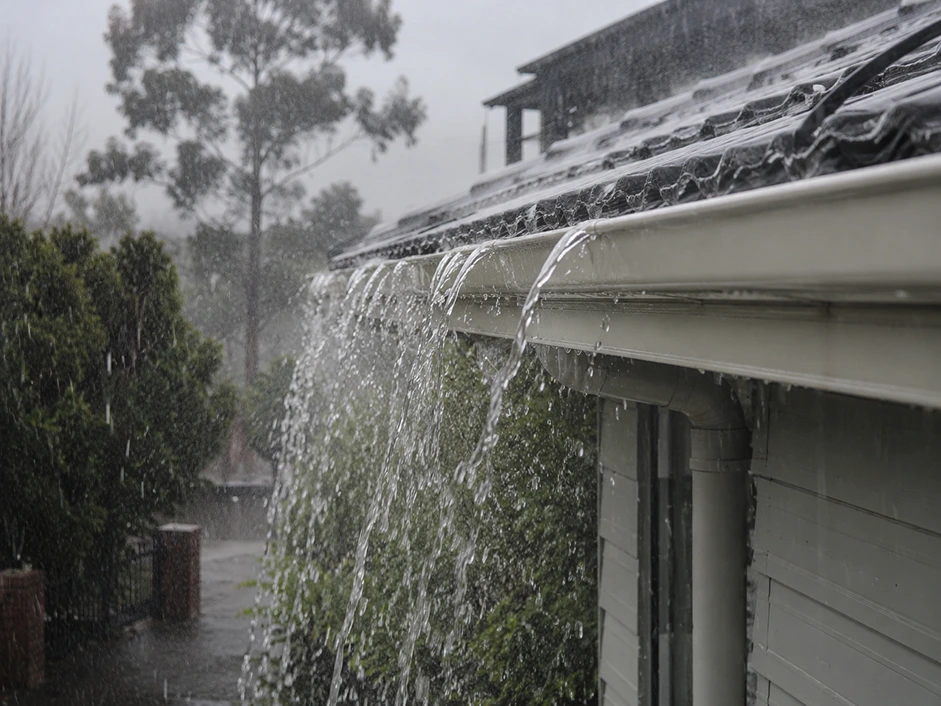
As storm fronts move across Port Phillip Bay, the flat western plains sit in a "rain shadow". But as those systems hit the rising elevation of the eastern suburbs, they are forced upward. The air cools and dumps higher volumes of rain the further east you travel. But it's not just the total amount of rain that causes roofs to fail; it is the intensity of the downpours.
The Bureau of Meteorology (BOM) tracks days where rainfall exceeds 25 millimetres. In the roofing industry, we call these "gutter-testing days." Standard residential gutters and downpipes are simply not designed to handle that volume of water hitting the roof all at once.

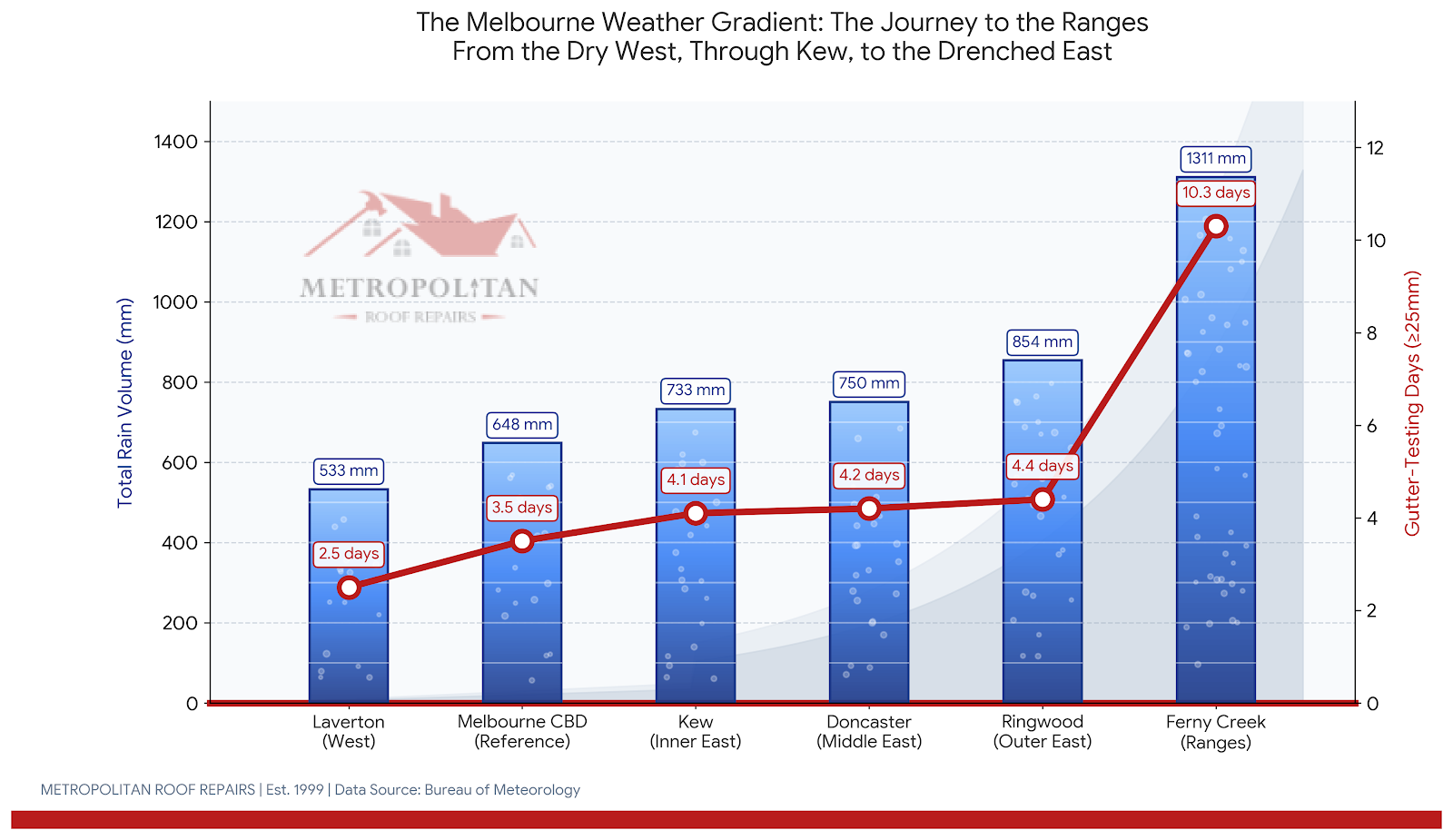
As you can see, a homeowner in Ringwood experiences significantly more rain—and more flash-flooding events—than someone in the CBD, and almost double that of someone out west. If a home in Laverton and a home in Ringwood have the exact same standard gutters, the Ringwood home is going to leak first.
Practical Advice: What Your Suburb Means for Your Roof
Based in Kew, Tom, Steve, and the Metropolitan Roof Repairs crew service a 25-kilometre radius across Melbourne's east. Because we inspect hundreds of roofs across this specific corridor every year, we know exactly how the local weather exploits different types of homes. Here is what you need to look out for based on where you live.
Zone 1: The Inner East (Kew, Hawthorn, Balwyn, Camberwell)
These suburbs are known for beautiful heritage homes, stunning period architecture, and streets lined with massive, mature trees. While they are protected from the extreme rain volumes of the outer east, the environment poses unique challenges.
| Location | Average Annual Rainfall | High-Intensity Days (≥25mm) |
|---|---|---|
| Laverton (Western Baseline) | 533 mm | 2.5 days |
| Melbourne CBD | 648 mm | 3.5 days |
| Kew / Hawthorn | ~733 mm | 4.1 days |
- The Blocked Valley Threat: The biggest cause of leaks in the Inner East isn't storm intensity; it's tree debris. Leaves and twigs constantly fall into roof valleys (the metal V-shaped channels where two roof angles meet). When it rains, this debris dams up the water, forcing it backward under your terracotta tiles and straight onto your plasterboard.
- Thermal Shock on Heritage Terracotta: Older terracotta tiles are brilliant, but after 60+ years, they become brittle. When a 38°C summer day is suddenly interrupted by a freezing afternoon thunderstorm, the rapid temperature change causes these aged tiles to crack straight down the middle.
- Homeowner Action: Ensure your roof valleys and gutters are cleared every autumn. Have a professional inspect your cement ridge pointing; if it is crumbling to powder, it needs to be replaced with modern, flexible acrylic pointing.
Zone 2: The Middle East (Box Hill, Doncaster, Burwood)
As you move further east and the elevation begins to shift, homes are exposed to slightly more rainfall and higher wind shear, particularly in elevated areas like Doncaster Hill.
| Location | Average Annual Rainfall | High-Intensity Days (≥25mm) |
|---|---|---|
| Doncaster | 750 mm | 4.2 days |
| Box Hill | ~760 mm | 4.2 days |
| Burwood | ~770 mm | 4.3 days |
- Aerodynamic Lift: Severe winds moving across elevated areas create a vacuum effect right above your roof. This invisible force physically pulls upward on loose metal sheets and coaxes brittle tiles out of their seated positions. When the rain arrives hours later, the roof's exterior envelope is already breached.
- Sarking Degradation: Many homes built in these areas during the 1970s and 1980s have internal sarking (the protective foil paper beneath the tiles) that has become torn or brittle. When wind drives rain sideways, there is no secondary barrier to stop it hitting your ceiling.
- Homeowner Action: Listen to your roof during high winds. If metal sheets are loudly ticking or banging, your roofing screws have backed out and the waterproof rubber washers have failed. They need replacing immediately.
Zone 3: The Outer East (Ringwood, Croydon, Mitcham)
Sitting at the gateway to the Dandenong Ranges, these suburbs take a heavy beating. With annual rainfall pushing past 800mm and nearly double the high-intensity storm days of the western suburbs, water volume is your biggest enemy.
| Location | Average Annual Rainfall | High-Intensity Days (≥25mm) |
|---|---|---|
| Mitcham | ~820 mm | 4.3 days |
| Ringwood | 854 mm | 4.4 days |
| Ferny Creek (Ranges Reference) | 1,311 mm | 10.3 days |
- The Gutter Overwhelm: Standard 115mm quad gutters simply cannot process the volume of water during a heavy spring downpour in the Outer East. The water backs up under the eaves, rotting out your timber fascia boards and flooding your ceiling insulation.
- Winter Saturation and Mould: Because it rains so frequently here during winter, porous concrete and terracotta tiles never fully dry out. This persistent dampness leads to heavy moss growth. Moss roots physically eat into your roof mortar, destroying the structural integrity of your ridge capping.
- Homeowner Action: Standard gutters are a liability in this zone. Consider upgrading to high-capacity guttering and larger downpipes to handle the flash-flooding volume. If moss is visible from the street, your mortar is already under attack and requires a high-pressure clean and re-point.
The Homeowner's Quick-Check Decision Guide
Not sure what to look for? Use this simple table to determine if your roof is struggling to cope with your local weather conditions.
| What You Notice | The Likely Weather Cause | The Recommended Fix |
|---|---|---|
| Water overflowing the gutters during heavy storms | Gutters are either blocked by tree debris (Inner East) or undersized for the rainfall volume (Outer East). | Gutter clearing and potential upgrade to high-capacity downpipes. |
| Brown water stains appearing on your ceiling | A cracked tile (thermal shock), rusted valley, or broken roof seal has let water penetrate the cavity. | Emergency leak detection, tile replacement, and cavity drying. |
| Mortar on the roof ridges looks crumbly or missing | Years of expansion and contraction from summer heatwaves have destroyed the old cement bonding. | Full roof re-pointing using modern, flexible acrylic compounds. |
| Metal roof ticks or bangs loudly in the wind | Aerodynamic lift has loosened the roofing screws, compromising the waterproof seal. | Re-screwing the roof with oversized, weather-sealed fasteners. |
Don't Wait for the Next Storm Front
A standard roof won't protect you if it wasn't built for your suburb's weather. Tom, Steve, and the entire crew at Metropolitan Roof Repairs have over 30 years of experience keeping Melbourne homes dry. From Kew to Croydon, we know exactly what your roof needs to survive the local climate.
If you need the most trusted roof repairs in Melbourne, don't wait for the next torrential downpour. We do it right the first time, and every repair or restoration we complete comes with a 10-year guarantee.
Get Your Free Localised Roof Quote Today